by
Summary: Property Inheritance Without a Will in India depends on the deceased person’s religion, family relationships, and applicable succession laws. This guide explains who inherits a house or land, how shares are determined, and the steps legal heirs should follow.Understanding Property Inheritance Without a Will in India is essential for families who want to protect their legal rights and avoid ownership disputes.
When someone dies without leaving a valid will, their property is distributed according to legal inheritance rules. This situation is known as intestate succession. Property Inheritance Without a Will in India can involve a surviving spouse, children, parents, and sometimes other relatives. However, not every family member automatically receives an equal share. The applicable law depends on personal law, the ownership of the property, and the deceased person’s circumstances. Understanding these rules helps families avoid disputes, identify rightful heirs, and complete property transfer procedures correctly.
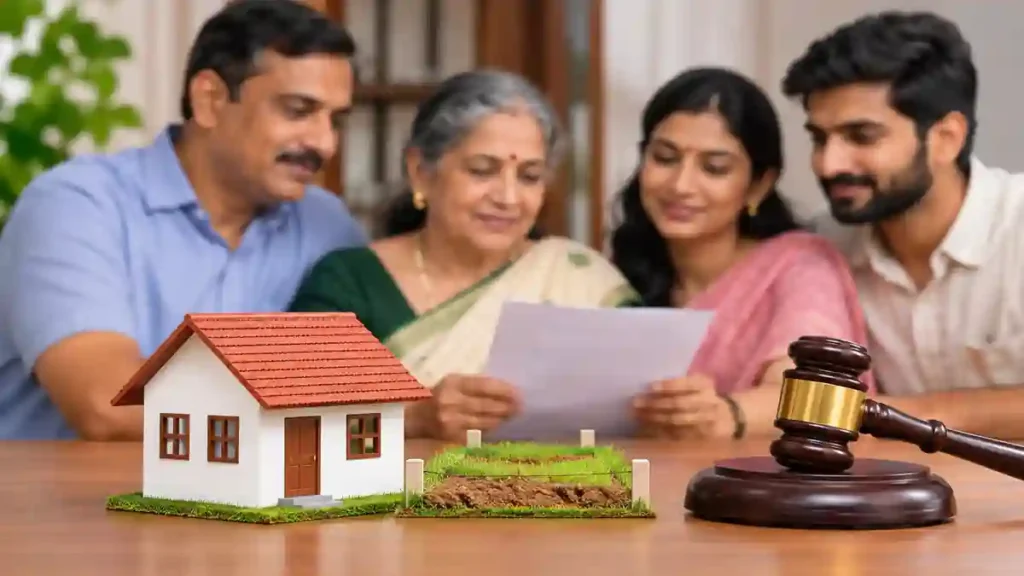
1. Who Gets Property Inheritance Without a Will in India?
India has different inheritance laws for different communities. For Hindus, Buddhists, Jains, and Sikhs, the Hindu Succession Act, 1956 generally governs intestate inheritance. Muslims are generally governed by Muslim personal law, while the Indian Succession Act, 1925 applies to many Christian and Parsi succession cases.
The rules also depend on whether the deceased was male or female. A jointly owned property, inherited property, or property belonging to a Hindu joint family may require additional legal examination. Before calculating inheritance shares, families should establish who legally owned the property and which succession rules apply.
2. Who Inherits a Father’s Property After His Death?
Under the Hindu Succession Act, when a Hindu man dies without a will, his Class I heirs receive priority. These include his widow, mother, sons, and daughters, along with certain descendants of predeceased children.
For example, if a man leaves behind his wife, mother, one son, and one daughter, each generally receives one-fourth of his separately owned property. Married daughters have the same inheritance rights as unmarried daughters. Brothers and sisters ordinarily inherit only when no Class I heirs exist, subject to the statutory order of succession.
3. Who Inherits a Mother’s Property Without a Will?
When a Hindu woman dies intestate, her sons, daughters, and husband generally inherit first. Children of a predeceased son or daughter may also inherit according to the law.
If none of these heirs exists, different succession categories apply. Special provisions can also affect property inherited from her parents or husband. Therefore, families should not assume that the inheritance rules for a deceased father and mother are identical.
4. Do Muslim and Christian Families Follow the Same Rules?
No. Under Muslim personal law, inheritance shares depend on the surviving relatives and the applicable school of law. Sons and daughters may receive different shares, and spouses and parents can have prescribed entitlements.
For Indian Christians generally governed by the Indian Succession Act, a surviving spouse ordinarily receives one-third of the estate when the deceased leaves lineal descendants, while the descendants receive the remaining two-thirds. Other family situations follow different rules. The precise legal position should be checked before distributing property.
5. How to Transfer House and Land After Death
Families dealing with Property Inheritance Without a Will in India should complete the relevant documentation and revenue procedures.
- Obtain the death certificate from the appropriate local authority.
- Identify all legal heirs and obtain the relevant legal heirship documentation.
- Collect property records, including title deeds, land tax receipts, and ownership details.
- Determine inheritance shares under the applicable succession law.
- Apply for mutation through the relevant village or revenue office.
- Execute a registered partition or release deed, where legally necessary and agreed.
- Update relevant records after completing the required procedures.
Table of Contents
Mutation updates revenue records but does not independently establish ownership. A succession certificate is generally relevant to debts and securities, not automatically required for transferring every house or plot of land.
Proper documentation plays an important role in Property Inheritance Without a Will in India, especially when multiple legal heirs share ownership of the same property.
6. Can One Legal Heir Sell the Entire Property?
A legal heir cannot ordinarily sell the shares belonging to other co-owners without their authority. An heir may be able to transfer their own undivided interest, subject to applicable restrictions.
If heirs disagree about ownership or division, they may need a partition agreement, mediation, or a civil court proceeding. Families should verify title and obtain appropriate legal advice before signing sale documents.
Frequently Asked Questions
Can a married daughter inherit her father’s property?
Yes. Under Hindu succession law, a married daughter has the same inheritance rights as an unmarried daughter.
Does property automatically belong to the wife after her husband’s death?
Not necessarily. Other eligible legal heirs may also receive shares under the applicable law.
Is a legal heir certificate enough to prove property ownership?
No. It helps establish family relationships but does not conclusively determine title or inheritance shares.
Can inherited property be transferred online in Kerala?
Certain revenue services are available online, but documentation, verification, and registration requirements depend on the transaction.
Conclusion
Property Inheritance Without a Will in India follows specific legal rules rather than informal family arrangements. Identifying the correct heirs, calculating their shares, and completing the necessary documentation can help protect ownership rights and prevent future disputes.Following the correct legal procedures makes Property Inheritance Without a Will in India easier to manage and helps families avoid unnecessary complications.
Emergency Fund: 7 Easy Steps to Build Your Safety Net in 2026